
An Intergenerational Conversation

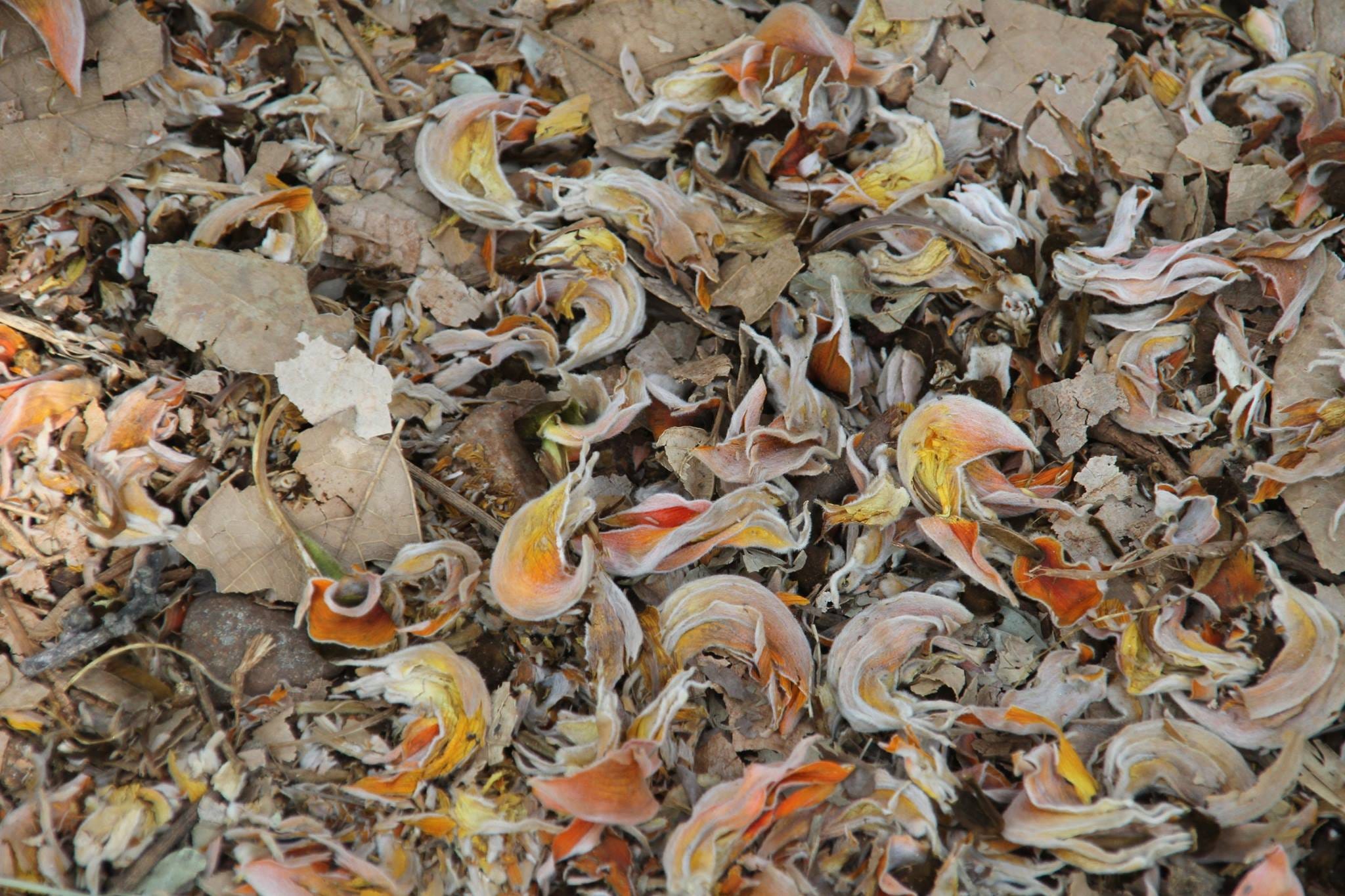
Fallen leaves at The Valley School, Bengaluru, India. Photo Maggie Alexander.
Welcome to 3D Yellow: June 25th to 29th Avila Spain. The fourth annual 3D Yellow gathering to take place for around thirty people.
We are a mixed bag of humanity with ages stretching from Laurie, who is fifteen years old, to me; I am seventy-three. All with different backgrounds and different experiences brought together by a willingness, or perhaps even a passion for exploration. This room is full of questions. The scene is set where coercion is converted to freedom, competition to convivial collaboration and conflict to listening and understanding.
The first activity of the gathering happens to be the presentation of a piece that I have written as a quiet launch of the Revolution in Mind project. Those of us who are there take turns in reading sections of the piece I have called ‘Beyond Seventy’. It is the first draft of a proposed book. Laurie is there with his dad.
What follows is a transcript of the conversation that Laurie and I had almost three months after the gathering.
A: What brought you on this trip?
L: At school our year group had to do work experience, where you had to spend three days with an employer that you could do anywhere. When my brother was doing his he did it with my dad. So, I thought I’d do the same thing. My dad said he would be in Spain then, but I might be able to go with him. Later he said it was ok for me to go.
A: Did you have any impression of what you might be going to?
L: I suppose I was expecting it to be like a holiday if I’m honest, and every time I asked my dad, he said that he had no idea what to expect. I was quite nervous going into it; but I thought it would be a nice and easy way of doing my work experience. While everyone else actually getting jobs I would be in Spain.
A: When you arrived at the airport did you wait with your dad for a while, and then some people appeared?
L: Yes, I was with my dad in the cafe, and everyone was turning up. I mostly just stayed by myself. I was trying my hardest not to look like a typical moody teenager and not to interact with those people. I was really nervous, and I didn’t want to speak to anyone.
A: How long did that feeling last for?
L: I think most of the first day. I was trying not to interact with people because everyone was really excited to be there, and I was just a bit scared. I was just trying to settle down before I talked to anyone.
A: How did you gauge the atmosphere right from the beginning?
L: I thought everyone was just happy to see each other and I felt bit like an outsider but also felt quite welcomed by everyone. They were really relaxed and I was not relaxed. The fact that everyone was really comfortable with not knowing what was going to happen was not good for my nerves. I really didn’t like the idea that I didn’t know what was going to happen.
A: Had you had that kind of experience before?
L: No. As a teenager I felt like I had to interact with everyone. I wasn’t used to that kind of feeling.
A: When you say you had to, where did that come from?
L: I had I the idea that everyone there was quite intelligent and interesting in their own different ways, and I wanted to appear like I was also interesting in my own way. That’s what made me feel I had to talk to people and share myself with them.
A: Would you say this was a very new experience for you?
L: Yes, it was very strange. Going abroad, not knowing what I was doing, meeting all these new people and being with my dad. There wasn’t a timetable, there wasn’t a schedule which is obviously very different to what I do every day. Waking up and going to school and then going to Spain for a week to do whatever you want. Basically, the only thing that was timetabled in were the mealtimes. It was all very new, very strange.
A: How long did this feeling last for?
L: Definitely the first day that we got there. However, by sometime in the second day it was starting to fade because we had a meeting in the morning, and we had done a couple activities. They felt like ice breakers, and I pushed myself to talk to people because I knew that it would help throughout the experience to be able to push myself to do things I wasn’t comfortable with.
A: How did that feel?
L: It was hard, but I did feel much better for it. As difficult as it was, I knew that it was helping me, and I was becoming a better person for it. If I could do it with all these new people in this weird environment, then I could come home and do it there as well in a normal environment.
A: How would you describe the progression as the days went on?
L: I definitely became a lot more at ease throughout the whole thing, but there were times where I thought I would just go stay in my room and do nothing because that’s what I felt comfortable with. After pushing myself to do something I found so hard, I thought I deserved to take a break and step back for a minute and do what was normal.
A: Can you give some practical examples of things, interactions that connected you with the people and what was going on?
L: I think when we did the walk up to the ice-hole at the top of the hill, behind the house. It was the first night we were there, it all felt a bit spiritual, and it was weird. I wasn’t sure what was going on. We all just sat there in silence looking out into the distance. I think there might have been music playing and I found it all a bit odd. It was really peaceful and that’s when I realised that it wasn’t going to be so bad, because everyone was doing the same thing. No one knew what to expect and I thought it it’s going to be fine.
A: Was it an experience that you’d had before?
L: It was just different. I’d never spent time with so many people that I didn’t know without only speaking to my dad the whole time. Which I did do for the first few days. After that I was doing it independently most of the time and I was there as my own person rather than my being my dad’s son. I was there as me with all these other people. I felt like part of the community.
A: Was there a particular point at which you felt that transition happening?
L: I can’t really remember a specific moment. I remember on maybe the second or third day I sat down for dinner at a table where my dad wasn’t sitting, which was really different because I had to have my own conversations. My dad couldn’t do any speaking for me, and I couldn’t speak to my dad. I remember going up to my dad afterwards and saying I’ve just had my first mealtime without you, and I was quite proud, pushing myself to do that.
A: Did it did it require an effort then?
L: It did in a way. It was a couple days in, and I was used to talking to these people; maybe it wasn’t such a big step. It was a bit scary at first because I saw that the only place left was at a table was away from my dad, so I was forced to sit there anyway. It wasn’t a choice that I made; it was something I had to do which made it a bit easier.
A: How would you say your relationship with your dad changed over that time?
L: Well, I’ve always thought my dad was a bit weird compared to all my friends’ dads, because he’s quite creative and my friends’ dads are just normal dads. But seeing him in this environment where a lot of people were similar to him, made me realise that my dad isn’t that weird. Maybe my friends’ dads are the weird ones and they’re just quite boring people. I think I got closer to my dad because I could connect with the more creative side of myself, the more interesting side and the more confident side myself. I think I just appreciated my dad in a different way.
A: Were there any of the activities that took you out of your comfort zone? Or any of the activities that you felt were particularly effective in bringing about the change you have been describing?
L: Your activity on the first day on the first morning was quite eye opening to me. I thought your writing was really good and interesting. That whole idea of intergenerational learning, especially coming from my point of view as a teenager. It wasn’t something that had occurred to me as an idea and I found it really fascinating. We learn every day, I learn through my teachers and that’s just how it is; but it never really occurred to me that it could happen the other way round across different generations. Sometimes learning isn’t just like education, or not just all academics. Having a conversation with someone is learning in its own right.
There was another activity that it was about rituals and that made me realise that rituals aren’t just something about being spiritualistic because I always thought it was about spirits and stuff. I never really believed in that, but this activity made me realise that is something that we do in our everyday lives just to make things a little bit easier for ourselves. A way of motivating ourselves to do something as small as getting out of bed. I think that had a difference when I came back to England because I could implement that into my own life.
A: Have you done that?
L: I tried. I think when I come back to England, I did notice quite a big difference in myself, and I think my family did as well. Over time and going back to school it’s all just sort of faded which is annoying, but I still hold on to it, even a little bit.
A: Was there anything in particular about you that your family noticed when you came back?
L: One thing that stood out to me was we went on holiday a few weeks ago in Wales, maybe six weeks after we’d come back from Spain. My brother said to me that since I had come back from Spain, I was a much nicer person to be around. Coming from a sibling that means quite a lot because siblings typically argue most of the time. To hear that you’re a nice person to be around, especially from your brother, is quite special.
A: Since we’re talking about things changing, how do you view things now you’re back in school?
L: My immediate response to school when I first got back was that there’s nothing I can do about the education system, and I was quite annoyed about that. Especially as you and I had few conversations in Spain about your teaching and teaching in a state school, and talked about the differences between them. I think your way was really interesting. Going to state school is quite annoying, there are things that you can’t change, and you have to put up with. My attitude had changed from ‘oh my gosh this is really annoying I hate going to school’, to I need to put up with it; and there are more things that I can change than I realised. If I have a better attitude towards school then I’m going to do better, and I can do more independent learning that I realise. There are a lot more opportunities for me to improve my education outside of school than I thought. As I’ve been going back to school for longer that has faded, and I do get very fed up with school. However, I think I still have a better attitude to learning than I did prior to going to Spain. I think conversations with you really helped with that.
A: When you say have a better attitude to learning what do you mean by that?
L: I think just seeing the interesting side of things and a lot of subjects in school are interesting, but they’re taught in a boring way. If you can think about it by removing it from the school and instead thinking about it as if you’re having an interesting conversation with someone rather than the teacher just telling you facts. I think that makes school much more interesting. Also being able to apply your knowledge from school to outside of school makes learning a lot more enjoyable for me.
A: Have you talked to your friends at school at all about this the time with your dad in Spain?
L: Not really. They weren’t interested which is fair enough. To the ones who were interested I said that it was a weird experience, that I was with all my dad’s friends just learning a bunch of random things and it was a lot of fun. They didn’t really ask any follow up questions after that. I don’t think I could word it in a way that any of my friends would really understand what I was doing as it was quite a hard thing to explain. It’s not something that it’s a kind of recognisable experience.
A: Has your experience made you think further ahead in terms of what you want to do with your life?
L: I think it’s probably made it a little bit of a hard decision to decide what I want to do with my life, because I realise that there are so many more opportunities and different things I could do that I didn’t really think of is a career path before. So many people that were in Spain had interesting jobs and I realised that that is something that is a possibility for me as well, rather than just going into a normal job.
A: Your dad doesn’t have a normal really job either. What did you think about?
L: I never really knew, and I still don’t really know that much about his job. I know it’s really interesting, being able to write for loads of companies and stuff, but I find it quite confusing. I don’t really know what he does.
A: How would you describe the way you were treated by the other people there?
L: I was expecting when I got there to be treated as a child as I had come with my dad. However, the more I integrated myself into the community the more I felt like everyone was being treated the same. I was being treated like an adult and everyone else was being treated like adults as well. It felt like a family where everyone had their own place, and we could all share our thoughts with each other. I didn’t feel like people saw me any differently just because I was younger. Everyone was fascinated to hear what I had to say, and I was fascinated to hear what other people had to say which made it a lot easier being part of that community.
A: Something I am very interested in is this intergenerational interaction, so how important do you think that is to for this sort of thing to take place?
L: I think it’s really important because if no one had appreciated the fact that there would be intergenerational interactions during our time in Spain that it would have made it a lot harder for people to listen to one another. If say I didn’t understand the whole idea of it, I would have struggled to have conversations with you and most of the other people, because I was the youngest by quite a long way. I think the fact that everyone appreciated that intergenerational communication is so important made it a lot easier for us to understand each other in an interesting way.
A: In your life have you had much of this type of intergenerational communication?
L: I feel like it’s sort of a thing that a lot of people take for granted. I definitely did before Spain because most of the learning I do is me just going into school and that is across generations. But that is what’s been normalised as adults telling children what to do. I think outside of school now I’ve had this idea of intergenerational interactions I notice in my everyday life where I’m learning a lot more just through conversations with people across different generations.
A: Do you have much contact with people younger than yourself?
L: I have two younger cousins and that is about it. I don’t really talk to people younger than myself.
A: Not even at school?
L: Not really. I’m not sure why but in school people find it a bit weird if you’re talking to people in the younger years. Every now and then I’ll find myself talking to a year seven because they’re new to the school. I try to be a nice year 11 because I know what it’s like having people being horrible to you. Other than that, I don’t really talk to so many people younger than me.
We laughed at this, acknowledging the implications and realising that this was a good place to finish this conversation. Laurie was about to embark on his GCSE mock exams and needed time to revise.
3D Yellow is held by www.yellowlearning.org : a space for learning.
A space for learning. Not a classroom, not a school nor a university, a space. The space that is a designated environment in which there is the freedom to learn.
Revolution in Mind has emerged from this space.
Hello there, Andrew. This was super interesting to read, a Yellow interaction where I was a fly on the wall and I thought Laurie's honesty was wonderful and what he spoke about is true for many adults although I'm not sure he would believe that.